US-Israel and Iran Conflict Escalates: Strikes on Tehran Oil Depots and Retaliatory Gulf Attacks
Scene Description
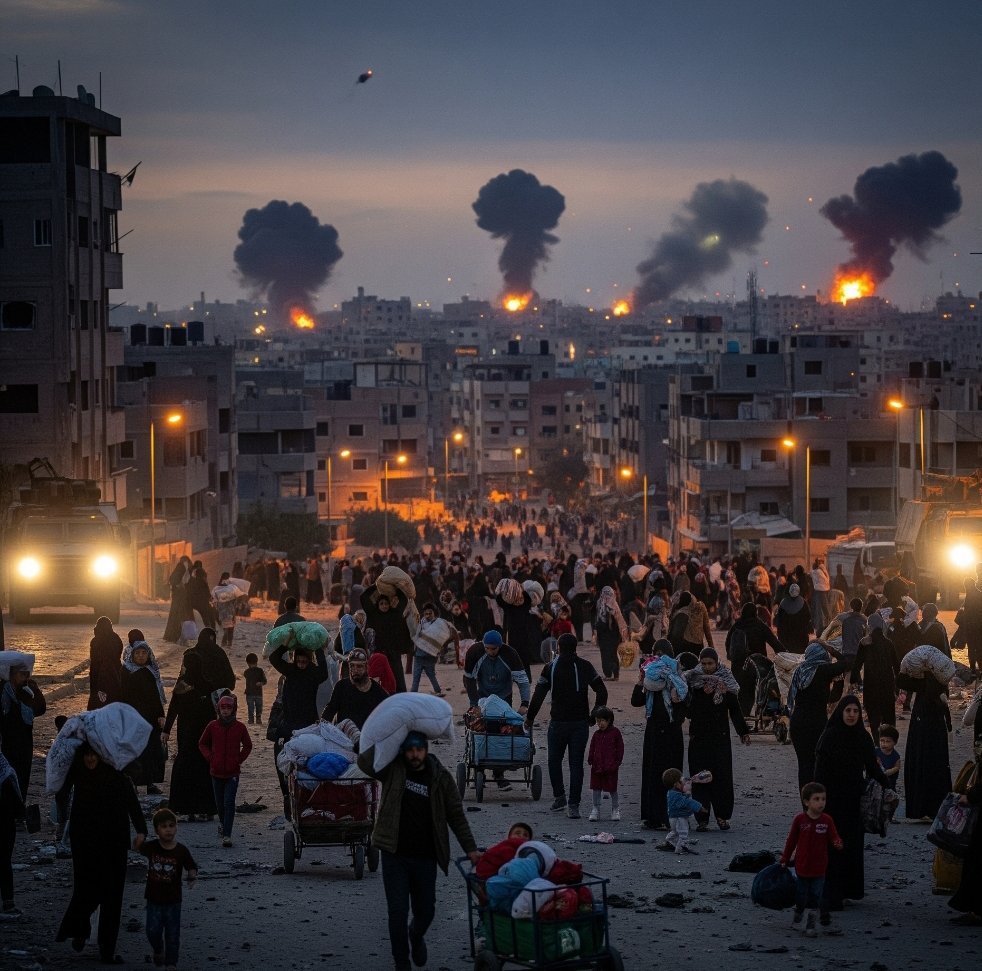
The night sky above Tehran is painted a violent, glowing orange. Massive, towering pillars of black smoke billow into the upper atmosphere, illuminated from below by ferocious, churning fireballs. Sirens wail endlessly in the distance, cutting through the low, guttural roar of the blazing oil reserves. The air is thick, choking, and heavily scented with scorched petroleum.
Action
Israeli and American fighter jets streak invisibly across the high-altitude darkness, deploying precision-guided munitions. Below, the Shahran and Karaj fuel storage complexes erupt in cascading, earth-shaking detonations. Emergency response vehicles, their lights flashing a frantic red and blue, race down the adjacent highways as firefighters desperately deploy high-pressure foam cannons against the towering inferno.
The escalating conflict in the Middle East has crossed a critical threshold this weekend. In a coordinated and highly destructive overnight operation, United States and Israeli military forces launched aggressive precision strikes against major Iranian energy infrastructure. In immediate retaliation, Tehran has unleashed a barrage of drones and ballistic missiles aimed at vital targets across neighboring Gulf states.
This unprecedented direct military engagement marks a severe expansion of hostilities, directly targeting Iran’s lifeblood—its oil industry. The Israeli military confirmed the strikes, stating that the targeted fuel storage and energy complexes in the Tehran and Alborz provinces were being heavily utilized by Iran’s armed forces to distribute fuel to military entities.
The Damage in Tehran
Iranian officials acknowledged the devastation early Sunday morning. Keramat Veyskarami, CEO of the National Iranian Oil Products Distribution Company, reported that enemy aircraft struck at least four major oil depots and a petroleum products transport center. Despite the catastrophic visuals of the burning Shahran oil depot—a facility previously targeted last June—and the depot in Karaj, Iran’s Ministry of Oil has emphasized that precautions were in place and no immediate domestic fuel shortages are expected.
The strategic choice to target these facilities underscores a shift in the allied military approach following a week of diplomatic clashes and military maneuvers. The goal is to cripple the logistical capabilities of the Islamic Revolutionary Guard Corps (IRGC) and force the regime’s hand.
Character Description: Iranian President Masoud Pezeshkian
President Masoud Pezeshkian appears visibly strained and fatigued, standing rigidly behind a wooden podium. He wears a dark, collarless suit jacket typical of Iranian state officials, his hair visibly graying at the temples. His expression is locked in a grim, defiant scowl, his eyes narrowed sharply against the glaring studio camera lights.
Character Voice Description
His voice is deep, gravelly, and resonant, carrying a measured but unmistakable tone of hardened defiance and political urgency. He speaks with deliberate pacing, emphasizing his words with sharp, rigid downward hand gestures.
Dialogue
“A demand by the United States for an unconditional surrender is a dream that they should take to their graves. I personally apologize to our neighboring countries that were affected by our defensive actions, but we will respond firmly and without hesitation to attacks originating from U.S. bases in the region.”
The Demand for Surrender and the Human Toll
The human cost of the conflict is mounting rapidly. According to Iran’s United Nations ambassador, Amir Saeid Iravani, the U.S. and Israeli operations have resulted in over 1,300 civilian casualties in Iran. Meanwhile, Iranian retaliatory strikes have proven deadly for American personnel stationed in the Gulf.
Six U.S. Army Reserve soldiers were killed in Kuwait when an Iranian Shahed-style drone struck their tactical operations center. Defense officials noted that the command post lacked sufficient overhead protection to withstand the direct aerial assault.
Scene Description
The tarmac at Dover Air Force Base in Delaware is bathed in the stark, cold light of industrial floodlights against the pre-dawn darkness. A solemn, heavy silence hangs over the expansive airfield, broken only by the sharp, synchronized footsteps of the military honor guard. The massive grey fuselage of a C-17 Globemaster III looms in the background, its loading ramp lowered to the pavement.
Action
The honor guard, dressed in immaculate full ceremonial uniform, moves with slow, meticulous precision. They carry flag-draped transfer cases slowly down the ramp of the military aircraft. The President raises his right hand in a crisp, sustained salute, holding the pose motionless as the remains of the fallen service members are transported to the waiting mortuary vehicles.
Character Description: U.S. President Donald Trump
President Donald Trump stands tall on the tarmac, wearing a dark navy overcoat tailored sharply at the shoulders and a signature red “USA” baseball cap pulled low. His posture is rigid, commanding, and formal. His face is set in a somber, unyielding mask as he observes the dignified transfer, his jaw tight.
Character Voice Description
His voice is firm, loud, and projecting, marked by his distinct rhythmic cadence and forceful emphasis on key adjectives. There is a sharp, uncompromising edge to his tone as he addresses the press pool over the ambient, low-frequency hum of the airfield.
Dialogue
“We are hitting them very, very hard. They have lost. They are apologizing to their neighbors because they know they are completely outmatched. We will not tolerate these attacks on our great service members. It was done by Iran, they have no accuracy whatsoever, and they are going to pay a very heavy price.”
Iran’s Retaliation: Gulf States in the Crosshairs
Following the bombardment of Tehran, Iran’s IRGC executed swift retaliatory measures against U.S. interests and allied infrastructure in neighboring Gulf nations. The geopolitical fallout is severely impacting global markets, driving up crude oil prices and forcing the closure of vital airspace across the Middle East.
Scene Description
The midday sun beats down relentlessly on the arid, concrete expanse of the Ali Al Salem Air Base in Kuwait. Charred, twisted corrugated metal and the smoldering wreckage of a tactical operations center mar the otherwise orderly military installation. Across the Persian Gulf in Bahrain, a massive industrial water desalination plant sits severely damaged; high-pressure water gushes violently from ruptured industrial pipes, pooling rapidly alongside scorched concrete blast barriers.
Action
An Iranian Shahed-style drone nose-dives from the clear blue sky, slamming into the Kuwaiti military compound with a deafening, concussive crack. A burst of brilliant orange flame and dark gray smoke violently expands outward, sending visible shockwaves that rattle nearby reinforced concrete walls. Simultaneously, automated Patriot air defense systems fire rapidly into the sky, leaving trailing white smoke paths as they intercept incoming projectiles over the desert landscape.
The scope of the Iranian response has been vast, severely impacting global and regional government stability:
- Kuwait Embassy Closure: The U.S. State Department has officially closed its embassy in Kuwait City. Drones have been intercepted at dawn, and authorities are warning the public of continuing missile threats.
- Bahrain Desalination Plant Hit: The IRGC targeted the United States’ Juffair base in Bahrain, claiming it was used to launch an attack on an Iranian desalination facility on Qeshm Island. The resultant strike caused significant material damage to a Bahraini desalination plant, a highly sensitive target given the region’s reliance on these facilities for drinking water.
- Aviation and Supply Chain Chaos: These strikes add to a growing list of regional disruptions across the Arabian Peninsula, heavily impacting commercial aviation similar to when Iranian strikes disrupted Dubai and Abu Dhabi airports. Major airlines have canceled operations throughout the region.
As the conflict shifts from proxy skirmishes to direct infrastructural warfare, the broader implications for global finance and energy sectors are profound. With diplomatic channels freezing and military assets fully mobilized, the prospect of an immediate ceasefire appears nonexistent.
Reader Poll: Impact of the Middle East Crisis
How significantly do you believe the current conflict will impact global energy prices in the next 30 days?Severe ImpactModerate ImpactMinimal Impact
Thank you for voting.
Live results are currently being tabulated globally.